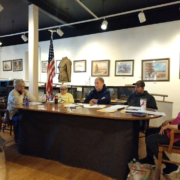
ExoticRidge resolution fails before Hawkins County Commission

ROGERSVILLE, Tenn. (WJHL) — Potential legal issues remain a center focus in Hawkins County after county commissioners did not vote on a settlement allowing crypto company ExoticRidge to begin construction and operate in Bulls Gap.

The resolution failed due to a lack of a second, meaning the settlement with ExoticRidge was rejected.

Hawkins County citizens clapped as no second was put forth, but this may mean legal trouble for the county.

Back in January, the crypto company put forth a settlement with Hawkins County, citing many “legal realities” that would allow the facility to establish itself, regardless of the initial ban put on crypto and data mining back in September.

“I understand why some commissioners and citizens thought a strong response was necessary,” Hawkins County Mayor Mark DeWitte said. “Strong action must also be lawful action. Decisions made outside of clear legal authority can expose taxpayers to expensive litigation and unintended consequences. Governing requires both responsiveness and restraint.”

DeWitte told the crowd that ExoticRidge met with the commission in an executive session in January, presenting its proposed settlement focused mainly on enforceable noise limitations. No votes were taken in that session, and DeWitte said he does not publicly endorse or oppose the company’s plans.

ExoticRidge CEO Will Daughtery addressed the commission and citizens, saying the company already had a substantial amount of documented commitments and permits before the September resolution was even passed.

He pointed out that Hawkins County failed to properly invoke the County Powers Act and cannot forbid a private company from establishing itself in the county.

“This commission had deemed Hawkins County a constitutional sanctuary,” Daughtery said. “Under Tennessee law, when a party incurs substantial obligations before a regulatory change, vested rights arise. Those rights are not discretionary. They are legal protections against retroactive government action. The resolution singled out one lawful land use and banned it outright without evidence of great impact, without water concerns, without air violations, and without attempting tailored regulation first.”

Regardless of possible litigation, many Hawkins County residents still do not want the facility in Bulls Gap.

Multiple public comments cited environmental and health concerns, as well as inadequate transparency from the commission or ExoticRidge.

“Mr. Will, when you were asked at the Bulls Gap City Hall meeting if you would be okay with your family or your children living near [the facility], you gave a very weak ‘no’ and moved on,” one resident said. “May I ask you what makes my family and my children any different?”

Some residents are glad the resolution failed; however, Hawkins County may find itself in possible legal trouble.

“Hawkins County comes to the problem too late with too little,” Commissioner Larry Clonce, who sponsored the resolution, said. “I understand your problems, but I don’t think we can win this fight.”

ExoticRidge sent a statement to News Channel 11 after the meeting:

We are disappointed in the Commission’s lack of action and resulting rejection of the settlement.

The agreement before the Commission addressed sound through enforceable limits and continuous monitoring across the entire operation. It provided a reasonable path forward while recognizing the substantial investments and binding commitments made before the ban was enacted.

Our legal rights under Tennessee law are not altered by tonight’s vote. We will consider our next steps carefully including almost certain litigation. Our preference remains a lawful, practical resolution grounded in facts.

ORIGINAL ARTICLE: https://www.wjhl.com/news/local/exoticridge-resolutions-fails-before-hawkins-county-commission/

Bulls Gap Dismisses longtime administrator Solomon

BULLS GAP — A controversial statement made by longtime Bulls Gap Town Administrator Mike Solomon — one in which he erroneously associated himself in his official capacity — cost him his job during Monday’s BMA meeting.

By a unanimous vote, the board chose to terminate Solomon’s contract immediately, and while he remained in the meeting to its conclusion, he placed his keys to the town facilities on the board’s desk before they adjourned, and gave Mayor Jim Riley some paperwork that he was no longer able to sign off on as soon as the meeting ended.

The board’s meeting-place in the Archie Campbell Museum was unusually full for the January meeting, as several concerned residents of the area attended to see what the board would choose to do in regards to Solomon, the town administrator since 2018.

The controversy involves the ongoing attempts by the ExoticRidge Crypto Company to set up operations just outside of Bulls Gap. Although the company has stated that it will use no public utilities and power its operations with generators using waste ethane from the NGL fractionalization plant next door, concerned citizens and elected officials in both Bulls Gap and Hawkins County cited similar situations in other areas where crypto operations and datacenters had a negative impact on the communities they were located in. The Hawkins County Commissioners passed a resolution in September barring such operations in the county.

ExoticRidge is contesting that decision. As part of the original application process, it had applied to the Tennessee Department of Environment and Conservation (TDEC) Air Pollution Control authorities for an air contaminant construction permit. It continued the process even after the County Commissioners’ decision, and a 30-day period for public comments opened on Sept. 23.

Solomon subsequently, on Dec. 1, asked TDEC Regional Director Jan Compton if he could “add my 2 cents, for all it is worth” relating to the application for the air contaminant construction permit for the generators proposed as part of the crypto mining operation. The permit was issued by TDEC on Jan. 7.

On Dec. 3, Solomon stated in a communication to the permit writer:

“I feel the permit should be issued, as based on current information, with Holston Electric’s generators, and Exoticridge’s (sic) generators operating on site, there will be no net emissions at this site. It seems to be that controlled combustion from an engine should be easier to adjust emissions, than it would be from the open combustion of the current flame. Electricity production, from the use of “cast off” fuel with no net increase of emissions, is a win-win for the efficient use of current and future supplies and resources.

Mike Solomon

City Adminstrator/CMFO

Town of Bulls Gap”

Although Solomon’s appears to be a minority position in the town and area, the main issue that the board and most of the citizens in attendance had was that Solomon signed the communication in his official capacity with the town, using the email address listed on MTAS, and not as a private citizen expressing a viewpoint. Solomon stated that he erred in not removing his professional credentials, but also said he had been asked for an opinion.

The communications between he and TDEC are a matter of public record and can be viewed on the agency’s online dataviewer, but did not become a point of controversy until local attorney Crystal Jessee posted them on social media on the evening of Jan. 11.

The fact that Solomon made the communication in an official capacity turned out to be the sticking point for the board. Solomon stated that he had done so in error and apologized for having done so, and also pointed out that his comments were not in support of ExoticRidge, but only that in his opinion, the proposed generators — a pair of 1,688kW engines that would run on the waste ethane — would have no negative environmental impact.

Riley said the communication itself “did not bother me a bit,” but that by associating himself in his capacity as town administrator, “in the eyes of the public, we support ExoticRidge. This is far from the truth.”

Alderwoman Leslie Tieke, who ended up being the second on a motion from Alderman Mike House to terminate Solomon’s contract, stated, as she has in the past, that she is 100 percent against crypto and data centers in the area and that such business brings nothing to the community, but reiterated what Riley had said earlier — that Solomon erred by signing with his title, and in so doing, created a perception that the Town of Bulls Gap supported ExoticRidge’s proposed crypto operation.

“I approciate Mike and everything he has done,” she said. “I accept his apology for his mistake, but it was a big one.”

Alderwoman Susan Williams stated “be careful what you put out and where you put it out.”

One person in the audience came to Solomon’s defense, while Jessee herself put in an appearance and distributed printouts of the full exchange between Solomon and the TDEC officials last month.

Eventually, Riley asked for a motion on whether or not to terminate Solomon’s contract, which had been signed on April 16, 2018 for a term of six years and then continued beyond April 2024 on an at-will basis. House made the motion, and for a moment it look like it might not get a second. However, Tieke seconded it after a pause of about 30 seconds, and then on a roll-call vote, all five members of the BMA voted for the motion.

By the terms of Solomon’s contract, four of the five had to vote to terminate.

He asked Riley if the termination was effective immediately, and when told that it was, he walked over to the board’s table and placed his keys there.

ORIGINAL ARTICLE: https://www.therogersvillereview.com/covid19/article_8e625e45-b16e-4a51-a3d3-5d5d07019bb7.html


Hawkins Commission bans crypto farms, datacenters

Residents of Bulls Gap came out in force Monday against a proposed crypto farm and asked the Hawkins County Commissioners to ban such operations in the county. The crowd was standing room only and many people had to wait in the hall outside the building.

STOP the Crypto Mine – Kingsport Times News

After the Kingsport Times News reported last week that ExoticRidge Crypto Company applied for a construction permit in Bulls Gap, many of the area’s residents decried the company’s plans for a cryptocurrency mining operation.

Attorney urges local utilities to sue over water contamination from PFAS chemicals

A Greeneville attorney is urging utilities in Northeast Tennessee to join a new lawsuit against manufacturers of potentially cancer-causing chemicals.

Greene County To Receive Over $333K From Opioid Lawsuit Funds

Greene County will receive $333,803 in opioid abatement trust funds from the Tennessee Opioid Abatement Council, according to the state Department of Mental Health and Substance Abuse Services.

The Opioid Abatement Council is making the first payments from opioid lawsuit settlements to counties totaling more than $31.4 million, a news release Friday states.

The state began processing direct payments from the Opioid Abatement Trust Fund to county governments this week.

Payments from these settlements, while not as large as this initial payment, will continue annually for 18 years.

In accordance with terms of the Distributor and Janssen/J&J settlement agreements negotiated by the Tennessee Attorney General’s Office, 35% of proceeds went directly to county governments “so that local leaders could direct spending on programs to address the effects of opioids on their citizens and communities,” the release states.

County leaders will be able to select various forms of treatment-related activities from a list approved in 2022 by the council. Approved uses “include a continuum of opioid use disorder treatment programs, medication assisted treatment, recovery supports, and prevention measures.”

Uses include training related to and increasing the distribution of nalaxone or other Food and Drug Administration-approved drugs to reverse opioid overdoses.

Increased distribution of medication-assisted treatment and other opioid-related treatment to individuals who are uninsured or whose insurance does not cover the needed service is also included on the list, along with education services to school-based youth and “youth-focused programs that discourage or prevent misuse.”

Funds could also be used to provide treatment and recovery support services such as residential and inpatient treatment, intensive outpatient therapy or counseling, and recovery housing to “allow or integrate medication and with other support services.”

Other state-approved uses for the funds included treatment for pregnant and postpartum women, expanding treatment for neonatal abstinence syndrome, treatment for incarcerated populations and funding for media campaign programs to prevent opioid use.

“There isn’t a county in Tennessee that hasn’t been touched by the opioid crisis. The funding going to these counties will have an immediate and much-needed impact. We are excited to get this funding out to all 95 counties of our great state, and we can’t wait to see how local leaders put it to good use,” said Dr. Stephen Loyd, Opioid Abatement Council chairman.

Loyd is a native of the Telford-Limestone area.

The remaining 65% of settlement dollars will be distributed through a competitive grant application process to be established by the Opioid Abatement Council. The processes for applying for funding and scoring applications are on the agenda for the council’s next meeting at the end of February, the news release states.

The first payments to come from the Opioid Abatement Trust fund “mark a milestone in the state’s work to address the effects of the opioid crisis,” the release states.

“While no amount of money will be enough to completely heal broken communities, funds distributed through the Opioid Abatement Trust Fund will provide further resources toward recovery and assist in bringing this epidemic to a halt. The Tennessee Attorney General’s Office will not let up on holding opioid manufacturers and distributors accountable,” state Attorney General Jonathan Skrmetti said in the release.

The hope for funding from the Opioid Abatement Trust Fund in coming years “is that Tennessee communities begin to repair the damage that has happened and is still happening due to opioid addiction and that people are able to find new lives in recovery and achieve their full potential,” Marie Williams, commissioner of the Tennessee Department of Mental Health and Substance Abuse Services, said in the release.

Williams thanked Skrmetti and former state Attorney General Herbert Slattery and their staffs “because we know their efforts on this essential issue will help define how our state recovers from the opioid crisis.”

Tennessee’s Opioid Abatement Council was created by in 2021 by the state General Assembly to manage the disbursement of proceeds from lawsuits relating to opioids.

The Opioid Abatement Council “upholds the responsibility to ensure the disbursements of these funds go toward funding programs, strategies, expenditures, and other actions designed to prevent and address the misuse and abuse of opioid products and treat or mitigate opioid use or related disorders or other effects of the opioid epidemic,” according to the release.

To learn more about the Tennessee Opioid Abatement Council, visit the council website at tn.gov/behavioral-health/oac .

Article Source:

https://www.greenevillesun.com/news/local_news/greene-county-to-receive-over-333k-from-opioid-lawsuit-funds/article_37b49c74-b47d-11ed-a3ce-67849ec892fc.html